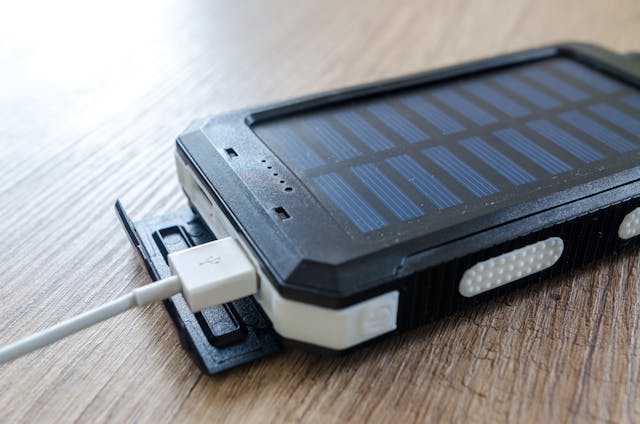
The number on the box is a laboratory maximum, and outdoors it is not what a panel delivers. Treeline Review, testing portable solar chargers over multiple days, states that none of the units it tried reached the manufacturer’s claimed fully-rated wattage. OutdoorGearLab, running panels into an identical power station on a clear day, measured most at 83 to 91 percent of their rating. Those two findings, plus published device capacities, are enough to work out what a day of sun actually buys, and it is less than most buyers assume.
Nothing Tested Reached Its Rating
Treeline Review’s portable solar panel testing was carried out by Chris Meehan, an outdoors writer of more than 20 years with a renewable energy specialism, across multiple days at campsites and at home, including hanging panels in full Colorado summer sun through a south-facing window with each unit attached to a USB digital tester and various battery packs. That outlet’s verdict, in its own words: “Despite multiple uses and attempts, none of the solar chargers we tested reached the manufacturer’s claimed fully-rated wattages for maximum power output during our tests.”
OutdoorGearLab reached the same conclusion with a tighter method and reported it as significant differences between claimed and actual capacity. Each panel was connected to an identical Jackery 1000 power station and measured over two hours in direct sunlight at 6,300 feet on a clear day, in temperatures of 55 to 65 degrees Fahrenheit, with input power recorded every 30 minutes. Review editor Kenji Mowrey, who holds a degree in outdoor product design from Oregon State, and Sam Schild, a full-time campervan dweller running 300 watts of roof solar, conducted the testing.
The conditions in that test matter as much as the results. Clear sky, cool air, thin atmosphere at altitude, panels angled toward the sun: these flatter photovoltaics. The 83 to 91 percent band is therefore a ceiling rather than an average. OutdoorGearLab’s review of the Renogy 200W notes that watt output fluctuates greatly from minute to minute and that the real world never has ideal conditions, and that using the kickstand legs increases efficiency by aiming the panel at the sun and keeping it cooler.
Measured Output Against Price for Large Folding Panels
The measured figures from OutdoorGearLab’s two-hour clear-day test are listed below with list prices and weights. Read the price column against the measured column rather than the rating.
- EcoFlow NextGen 220W: rated 220 watts, measured 193 watts, $649, 16.5 pounds
- JJN Bifacial 200W: rated 200 watts, measured 182 watts, or 91 percent of rating, $130, 25.0 pounds
- Renogy 200W Portable: rated 200 watts, measured 177 watts, $250, 14.8 pounds
- Jackery SolarSaga 200: rated 200 watts, measured 171 watts, $699, 14.2 pounds
- BougeRV Arch 200W Flexible: rated 200 watts, measured 166 watts, $280, 6.6 pounds
- Goal Zero Boulder 200 Briefcase: rated 200 watts, measured 166 watts, $600, 43.3 pounds
Brand Premium Does Not Buy Watts
The cheapest panel in that list posted the highest proportion of its rating. The JJN at $130 measured 91 percent. The Jackery at $699 measured 171 watts and the Goal Zero at $600 measured 166 watts, both below the $250 Renogy. The JJN pays for its output in mass, at 25 pounds, which rules it out of a rucksack but not out of a truck bed or a base camp.
The pattern is stronger among small USB chargers, where OutdoorGearLab tested 19 units for one hour in direct sun with Chris Maxcer as primary reviewer. Rated wattage turns out to be a poor predictor of delivered charge.
- FlexSolar 60W: 5,145 mAh in one hour, $70, described as delivering more than 45 watts with impressive consistency over USB-C
- FlexSolar 40W: 4,302 mAh per hour, $60
- EcoFlow 45W: 2,351 mAh per hour, $99
- BigBlue SolarPowa 28: 2,318 mAh per hour, $70
- Goal Zero Nomad 50: 1,619 mAh per hour, $250
- Blavor 10W: 1,401 mAh per hour, $40, ahead of the 18W Blavor at 692 mAh per hour and $70
- FlexSolar E10 Mini: 1,247 mAh per hour, $35
The Same Panel Class, Two Very Different Results
Comparing across outlets shows how much the weather does. OutdoorGearLab measured a 28 watt BigBlue at 2,318 mAh in an hour. Treeline Review measured a 28 watt BigBlue at roughly 950 mAh an hour, and a 28 watt Nekteck at 834 mAh an hour, on units weighing about 1 pound 5 ounces and 1 pound 7 ounces and costing around $67 and $60. That is a spread of well over two to one on the same class of hardware.
Neither number is wrong. Different days, different sun angles, different testers, different battery packs absorbing the charge. The honest way to use them is as a range, and the useful conclusion is that the conditions dominate the specification. Treeline’s list also includes the Goal Zero Nomad 50 at 6 pounds and $250, the BioLite SolarPanel 10+ at 10 watts, 1 pound 3.4 ounces and $150, and the BioLite SolarPanel 5+ at 5 watts and 13.76 ounces.
An Illustrative Calculation, Not a Measurement
What follows is arithmetic performed on figures published by others. It is not a test, and no equipment was operated to produce it. The inputs are Treeline Review’s measured 950 mAh per hour from a 28 watt panel, and GSMArena’s listed battery capacity for the Apple iPhone 16 of 3,561 mAh.
- At about 950 mAh an hour, refilling a 3,561 mAh phone battery takes roughly 3.75 hours of direct, well-aimed sun.
- That figure excludes charging losses, cloud, shade, heat, and a pack-mounted panel drifting off the sun’s axis as the walker turns. In practice all of those apply, so treat 3.75 hours as an optimistic floor rather than a schedule.
- Delivering 950 mAh an hour at 5 volts works out at about 4.75 watts, roughly 17 percent of the panel’s 28 watt rating. A panel of that size does not charge a phone in an hour.
- At the other end of the scale, Jackery states its Explorer 1000 v2 holds 1,070 watt-hours, weighs 23.8 pounds, accepts a maximum of 400 watts of solar input, lists at $879 and currently sells at $789, and recharges in 7.5 hours using a 200 watt SolarSaga panel.
- Those two vendor figures imply an average of about 143 watts sustained across seven and a half consecutive hours, roughly 71 percent of the panel’s rating held all day. Against measured outputs of 166 to 193 watts under deliberately favourable test conditions, that is an assumption a real day rarely supports.
The Part of the Review That Usually Goes Untested
Michael Febbo’s hands-on with the Jackery Explorer 1000 v2 for The Drive, published 17 October 2024, confirmed the 1,070 watt-hour capacity and recorded a wall recharge from about 30 percent to full in under 90 minutes. It documented no real solar charging times and no comparison of claimed against actual solar input. That is typical. A great many solar generator reviews never test the solar part, which is the only part whose performance is in doubt.
Two figures that commonly appear in articles like this one are absent here on purpose. This article states no peak sun hours value, because the tables carrying those numbers sit on solar installer marketing pages rather than on the National Renewable Energy Laboratory’s own published data. It also declines to define Standard Test Conditions, the laboratory setting that produces a rated wattage in the first place, because that definition belongs to the IEC 61215 standard and should be quoted from it rather than from memory. The rated-versus-measured gap documented above stands on the test results alone.
Sources: Treeline Review · OutdoorGearLab · OutdoorGearLab · GSMArena · Jackery · The Drive