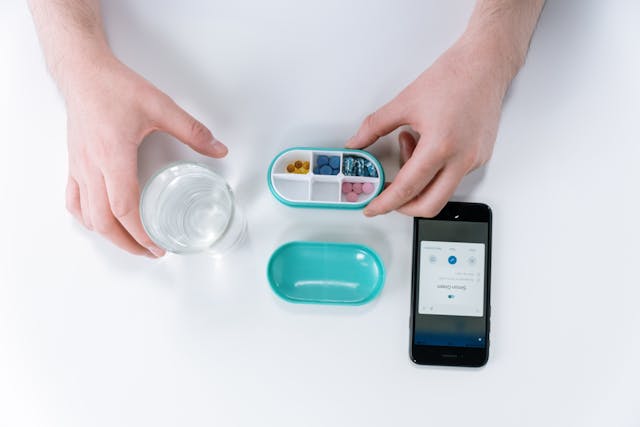
A connected pillbox lights a compartment, sounds an alert and tells an app or a family member whether the dose was taken. The proposition is reasonable and the engineering is straightforward. The claim attached to it in most coverage is a percentage improvement in medication adherence, usually credited to a study at an unnamed hospital. No such study underpins this article, and no percentage appears in it. What follows instead is the standard any adherence trial would have to meet, drawn from research fields where that standard has actually been applied.
Why No Adherence Percentage Appears Below
Techie Atlas verified a body of source material for this piece covering evaluation methodology in education and surgical training, vendor-published corporate training claims, and the support histories of connected consumer devices. It contains no randomised trial of connected pill dispensers and no independently published adherence outcome for one.
There are two ways to fill that hole and both are unacceptable. One is to attribute a figure to an unnamed hospital or a recent study, which is how fabricated statistics enter circulation and become uncorrectable, since a claim with no institution attached cannot be checked or retracted. The other is to quote a number from a manufacturer’s website and present it as a finding. Neither is done here.
Saying that the public evidence is thin is not a criticism of the devices. Plenty of sensible products have no strong trial behind them, because trials are expensive and nobody funded one. It is a criticism of the certainty with which the adherence claim is usually repeated.
The Shape of a Study That Would Settle It
Two recent pieces of medical and educational research show what happens when evaluation standards are applied properly, and both are instructive for anyone reading a pillbox claim. In 2026 Layadi, Huguet, Pavic and Chevalere published a stratified meta-analysis in Educational Psychology Review that sorted virtual reality learning studies by risk of bias. Pooled across everything, the technology showed a standardised mean difference of 0.55. Among studies rated at low risk of bias, the effect fell to 0.35 and was no longer statistically significant. The authors concluded that effects in the broader literature appear driven largely by work of lower methodological quality.
The 2022 BJS Open meta-analysis of virtual reality training for laparoscopic cholecystectomy, covering 15 randomised trials with usable data, shows a different failure mode. It found a clear improvement on one assessment instrument, OSATS, with a mean difference of 6.22 points, and no significant difference at all on another, GOALS, in the same body of trials. Which measuring instrument the investigators chose determined what the headline said.
A trial of a smart pillbox would need to clear both hurdles.
- Randomisation with a protocol registered before recruitment, so that outcomes cannot be selected after the data arrives.
- Risk of bias assessed with a published tool and reported openly, given how much that single variable moved the virtual reality result.
- An objective adherence measure such as pharmacy refill records or pill counts, rather than patients reporting how well they did.
- A fair comparator: an ordinary weekly pill organiser with a phone alarm, not an untreated control group. Comparing a new device against nothing at all measures the attention, not the device.
- Follow-up long enough for novelty to wear off, since a reminder is most effective in the weeks when it is still unfamiliar.
- A clinical endpoint where the condition permits one, because doses recorded as taken is a proxy for the outcome anyone actually cares about.
Reported Confidence Is Not a Measured Outcome
The most common substitute for an outcome is a satisfaction survey, and the corporate training field shows how convincing that substitute can look. Strivr, the vendor behind Verizon’s virtual reality programme, reports a 20-minute robbery-safety course delivered to upwards of 22,000 retail staff in more than 1,600 shops, after which 97 percent said they felt better equipped for a dangerous situation. The number is real, it is large, and it measures nothing about how anyone behaved during a robbery.
What a figure like that records is what participants said about an experience. Read alongside the stratified meta-analysis above, where measured learning gains thinned out as study quality rose while enthusiasm did not, the pattern is clear enough to carry across to medication devices.
Applied to a pillbox, it means that a manufacturer’s claim that most users found the device helpful, or that carers felt reassured, tells a buyer nothing about whether more doses were taken. Those may all be true at once. They are simply different questions, and only one of them is the reason the product is bought.
A Medication Device Is a Support Commitment
The second question worth more attention than the adherence claim is how long the reminders will keep arriving. If alerts, refill notifications or carer messaging pass through a manufacturer’s servers, they last exactly as long as that company chooses to run them, and the recent record on connected household hardware is not encouraging.
Google’s own support page records that Nest Learning Thermostats from 2011 and 2012 lost app control, remote access, notifications and cloud features on 25 October 2025, retaining only on-device operation. TechCrunch reported in July 2025 that Belkin would end support for most Wemo devices on 31 January 2026, taking remote access, voice integrations and the app with it, with a partial refund available only where a product was still under warranty. The Register documented Insteon shutting down its cloud servers in April 2022 with no notice at all, leaving switches working locally while automation and scheduling in the app stopped; an installer interviewed for that report said the company never contacted him. In March 2025 Amazon removed the option on three Echo models to keep voice processing off its cloud, telling The Register that expanded generative AI features relying on cloud processing were the reason.
The Wemo case contains the useful detail. Devices already configured in Apple HomeKit carried on working, because that control path runs locally rather than through Belkin. For a medication device the equivalent question is whether the box still beeps at the right time with the internet down and the manufacturer gone.
Questions to Put to a Seller Before Buying
None of this argues against buying one. A pillbox that sorts a week’s doses and makes a noise at the right hour solves a real problem for people managing several prescriptions. These are the questions that separate a supported product from an expensive one.
- Does the alarm and the compartment schedule work with no internet connection and no account?
- Who published any adherence figure quoted in the marketing, and does a citation lead to a journal article rather than to the company’s own blog?
- Was that figure an objective measurement of doses taken, or a survey of how users felt about the device?
- What was the comparison group, and was it a cheaper pill organiser or nothing at all?
- What is the published end-of-support policy, and what specifically stops working on that date?
- If carer notifications are the reason for the purchase, what happens to them if the company is sold or closes?
Sources: Educational Psychology Review · BJS Open · Strivr · Google Home Help · TechCrunch · The Register